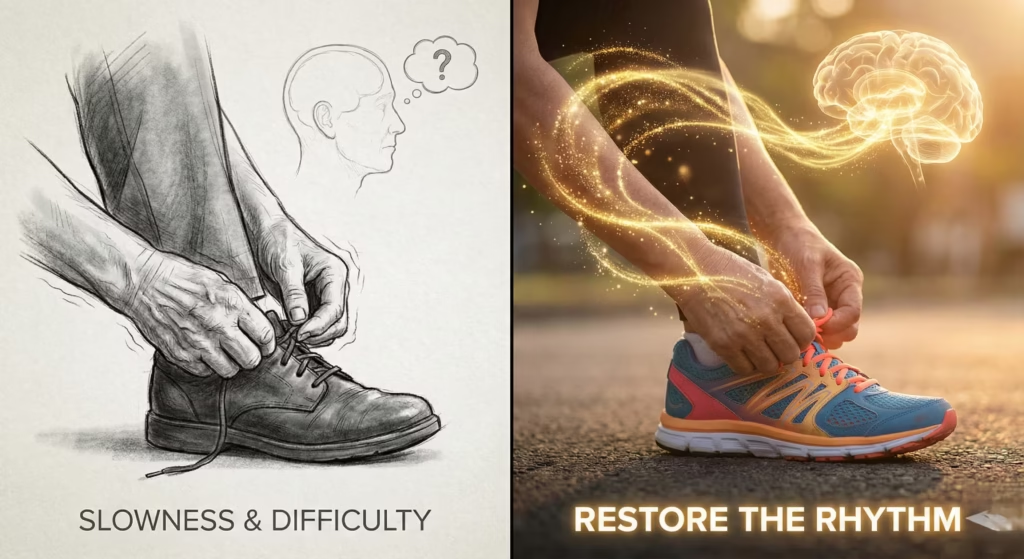
Notice a slight tremor in your thumb when your hand is resting? Or perhaps you feel like your walking has become slower, and your steps shorter? Maybe your handwriting has become tiny and cramped. These are not just signs of aging. These are the whispers of Parkinson’s Disease.
Receiving this diagnosis can feel frightening. You worry about losing your independence. You worry about the future. But here is the thing. Parkinson’s is no longer the scary sentence it used to be. With the right Parkinson’s disease treatment, life does not stop. In fact, many of our patients continue to work, travel, and enjoy their hobbies for decades after diagnosis. The key is catching it early and managing it with an expert who understands the minute details of the brain.
“Parkinson’s is not just about the shaking hands you see. It is about the slowness you feel inside. It is like driving a car with the handbrake on. Our job is to release that brake so you can move freely again.”— Dr. Anurag Lamba
The “Fuel Tank” Concept: Understanding Dopamine
To understand the treatment, you must understand the problem. Deep inside your brain, there is a chemical called Dopamine. Think of Dopamine as the fuel that helps your body move smoothly. In Parkinson’s disease, the cells that make this fuel start to fade away.
When the fuel level drops, the movements get jerky or slow. The goal of medication and therapy is simple. We either refill the tank (by giving dopamine substitutes) or we make the engine run more efficiently on the fuel it has left. This balance requires precise medical supervision.
Symptoms: It Is Not Just Tremors
While shaking (tremors) is the most famous symptom, it is actually just the tip of the iceberg. Many patients never shake at all. Here are the signs we look for:
- Bradykinesia (Slowness): Simple tasks like buttoning a shirt or getting out of a chair take much longer.
- Rigidity (Stiffness): Your arms or legs feel stiff and heavy, sometimes causing pain.
- Postural Instability: You might feel like you are going to fall backwards or lose your balance easily.
- The Masked Face: Your face might show less expression, making you look serious or sad even when you are not.
- Soft Voice: Your voice might become quiet or hoarse.
- Micrographia: Your handwriting becomes very small and crowded.
Real Patient Stories (Case Studies)
Every Parkinson’s patient is different. Here is how we customize care at our clinic.
Case Study 1: The “Frozen” Teacher
Patient Profile: Male, 62 years old, Retired Teacher.
The Problem: He didn’t have tremors, but he felt “stuck” when he tried to walk. His feet felt glued to the floor (Freezing of Gait). He became depressed and stopped going out.
The Diagnosis: Parkinson’s Disease with dominant rigidity.
The Treatment Path: We adjusted his medication timing to ensure a constant flow of dopamine. We also introduced “Cueing Therapy” (using rhythmic sound to help walking).
The Outcome: The freezing spells reduced significantly. He started his evening walks again, which improved his mood and mobility.
Case Study 2: The “Shaky” Artist
Patient Profile: Female, 54 years old, Painter.
The Problem: A resting tremor in her right hand was ruining her ability to paint. She feared her career was over.
The Diagnosis: Early-onset Parkinson’s.
The Treatment Path: Since she was young, we avoided strong Levodopa initially to prevent long-term side effects. We used dopamine agonists and specific hand exercises.
The Outcome: Her tremor is controlled. While she adjusted her painting style slightly, she continues to create art and hold exhibitions.
The “On-Off” Phenomenon
If you have been on medication for a while, you might experience something called the “On-Off” effect.
ON Period: The medicine is working. You can move freely and feel great.
OFF Period: The medicine wears off before the next dose. You suddenly feel stiff, slow, or stuck.
Managing this fluctuating cycle is an art. This is why you need the Best Neurologist in Panchkula to fine-tune your dosage. Dr Anurag Lamba specializes in smoothing out these peaks and valleys so you have more “good hours” in your day.
Beyond Medicine: Lifestyle as Medicine
Pills are only 50% of the battle. The other 50% is what you do at home.
- Big Movements: We teach exercises that force you to make big gestures. This retrains the brain to fight against the “shrinking” of movement.
- Voice Practice: Singing loudly or reading aloud helps keep the vocal cords strong.
- Diet Timing: Protein can sometimes interfere with Parkinson’s medication. We guide you on when to eat your meals for the best medication absorption.
Why Choose Dr Anurag Neuro Clinic?
Parkinson’s is a journey, not a one-time event. You need a doctor who walks that path with you. Dr Anurag Lamba is widely regarded as the Best Neurologist in Panchkula because he focuses on Quality of Life, not just the disease.
We monitor your progress closely. We adjust your plan as your life changes. Whether it is tremors, sleep issues, or mood changes, we address every aspect of the condition.
If you notice a tremor or feel that your body is slowing down, do not wait for it to get worse. Early Parkinson’s disease treatment preserves your brain health and keeps you active for longer. Schedule a consultation today and take control of your movement.